Decoding Human Brain Mechanics, Behavioral Circuits, and the AI Efficiency Divide
1. Core Architecture & System Mechanics
The human brain is an extraordinary, self-organizing organ weighing roughly three pounds and housing an estimated 86 billion neurons. Operating on electrochemical signals, it serves as the command center for cognition, emotional regulation, and physiological balance.
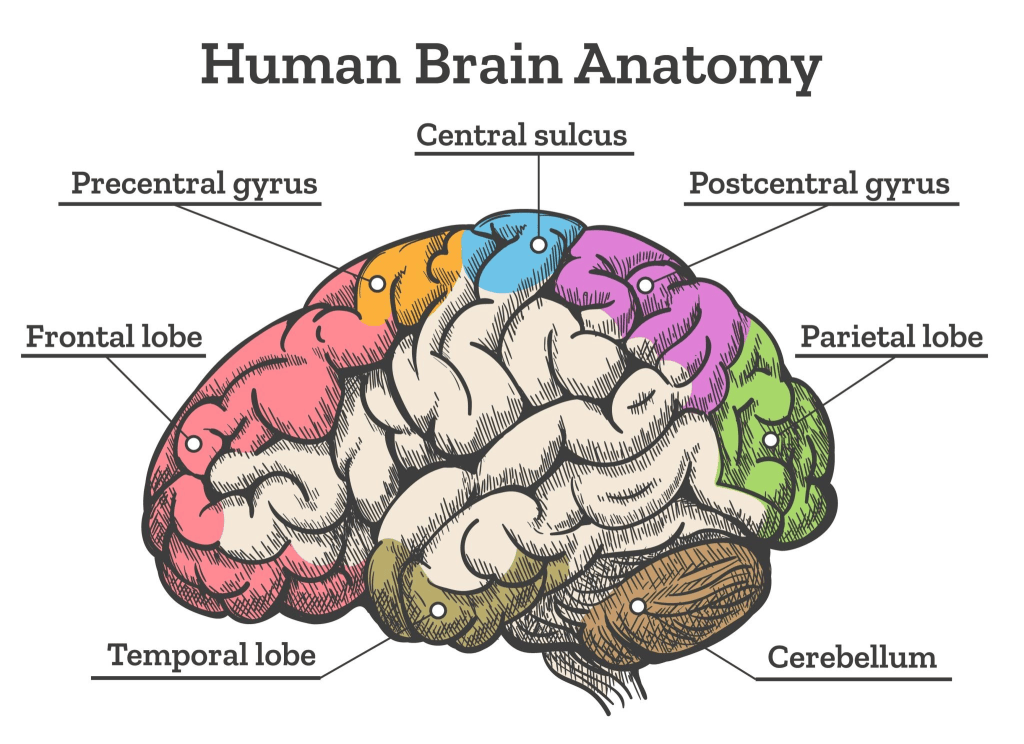
Major Anatomical Structures
- The Cerebrum: Divided into two distinct hemispheres, it processes higher-order functions via four functional lobes:
- Frontal Lobe: Governs executive function, strategic planning, reasoning, and voluntary motor output.
- Parietal Lobe: Integrates somatosensory information, including spatial mapping, touch, and temperature.
- Temporal Lobe: Manages declarative memory storage, auditory processing, and language comprehension.
- Occipital Lobe: Decodes visual stimuli and spatial color mapping.
- The Cerebellum: Located posteriorly at the base, it oversees fine motor control, balance, and procedural motor memory.
- The Brainstem: Regulates life-preserving autonomic functions, such as cardiac rhythms, respiration rates, and sleep-wake cycles.
Electrochemical Signaling & Plasticity
Neurons communicate via action potentials—electrical impulses running along myelinated or unmyelinated axons. Upon reaching a terminal axon, this electrical surge triggers the release of specialized chemical messengers (neurotransmitters) across a microscopic synaptic gap.
[Electrical Action Potential] ---> (Axon Terminal) ---> [Neurotransmitter Release] ---> (Synaptic Gap) ---> [Postsynaptic Receptor Engagement]
This structural architecture is constantly altered through neuroplasticity. When specific neural circuits fire repeatedly, their synaptic connections strengthen; underused pathways are systematically pruned away.
2. Neurochemistry: Dopamine, Serotonin & The Habit Engine
Neurotransmitters regulate emotional baseline, focus, and drive. Although often bundled under the colloquial banner of “feel-good chemicals,” dopamine and serotonin govern fundamentally distinct behavioral states.
| Metric | Dopamine System | Serotonin System |
| Primary Functional Role | Reward prediction, goal-directed motivation, motor control | Mood stabilization, impulse control, emotional equilibrium |
| Experiential Output | Anticipation, excitement, focused drive | Contentment, tranquility, calm satisfaction |
| Behavioral Trigger | Encountering or anticipating a rewarding cue | Social connection, restful states, exposure to light |
| Systemic Direction | Acquisition / Seeking: “Pursue that objective.” | Satiety / Maintenance: “I am balanced.” |
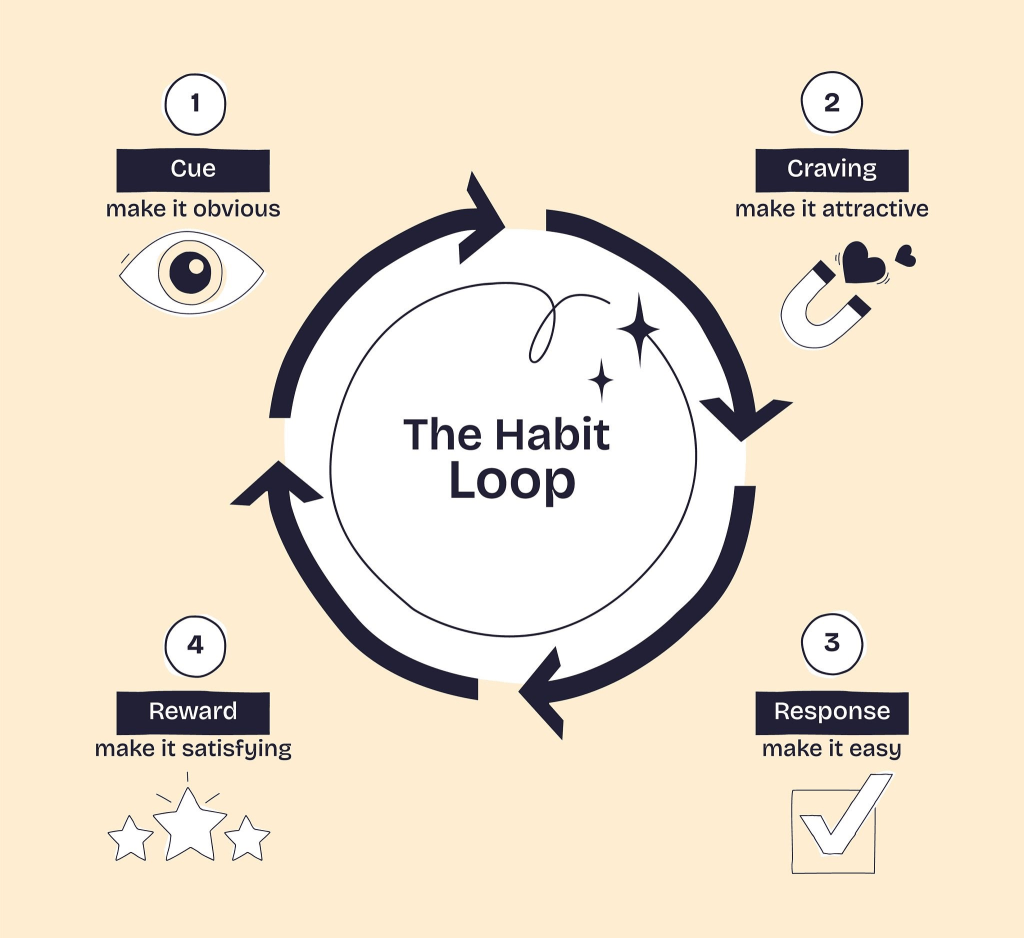
The Mechanics of the Dopamine Habit Loop
Dopamine does not simply register pleasure—it functions as a reward prediction error learning signal.
- The Cue: An environmental or internal trigger (e.g., boredom or a phone chime) signals a potential reward.
- The Craving: Dopamine surges before the action, creating an anticipatory drive to seek out the reward.
- The Response: The habit routine is executed (e.g., eating sugar or opening a social media feed).
- The Reward / Reinforcement: The brain registers the payoff, encoding the neural pathway deeper into the dorsal striatum.
Pathways to Addiction & Receptor Downregulation
When an individual engages with hyper-stimulating inputs—such as variable-reward algorithms or highly palatable foods—dopamine spikes well above natural evolutionary baselines.
To protect itself from neurotoxic overstimulation, the postsynaptic cell lowers its density of D2 dopamine receptors in a process called downregulation. This leads to tolerance: daily natural experiences feel flat or unrewarding, forcing the individual to seek high-intensity stimuli simply to achieve a normal baseline.
3. Rewiring Cravings & The Science of “Dopamine Fasting”
Popular culture often misconstrues “dopamine detoxing” as literally purging dopamine from the body. From a neuroscientific perspective, dopamine cannot be turned off; rather, deliberate periods of stimulus control give hyper-stimulated D2 receptors time to upregulate and regain sensitivity.
Science-Backed Strategies to Break Habit Loops
- Habit Substitution (HRT): Keep the original cue and underlying reward, but substitute a healthier physical routine in the middle.
- Injected Friction: Insert operational barriers (e.g., using phone grayscale modes or removing apps from the home screen) to force the conscious prefrontal cortex to take control before automatic routines run.
- Environmental Cue Audit: Alter surroundings to remove triggers before they cause dopamine to spike.
- Urge Surfing: Mindfulness practices teach individuals to sit with a craving wave without acting on it. Cravings typically peak and naturally dissipate within 10 to 15 minutes.
The 30-Day Digital Protocol
[Days 1-7: Environment & Friction] ---> [Days 8-14: Consolidation] ---> [Days 15-21: Deep Work Practice] ---> [Days 22-30: Long-Term Integration]
- Phase 1 (Days 1–7): Switch all personal devices to grayscale mode; eliminate screens from the bedroom; implement a 60-minute screen-free window upon waking and before sleeping.
- Phase 2 (Days 8–14): Disable non-human notifications; batch communication checks into 2 to 3 designated windows per day.
- Phase 3 (Days 15–21): Implement the “20-Second Friction Rule” (logout of social media platforms after every session); practice 30 minutes of low-dopamine, single-tasking daily.
- Phase 4 (Days 22–30): Audit habits to determine which digital tools genuinely add value; solidify permanent boundaries for sustainable focus.
4. Metabolic Energetics & Computational Throughput
The human brain achieves incredible operational efficiency by balancing a tight metabolic budget against massive computational processing power.
The 20-Watt Metabolic Paradox
- Total Power Draw: The brain runs continuously on roughly 20 Watts—less power than a dim household lightbulb.
- Proportional Energy: Representing just 2% of total body mass, it consumes approximately 20% of the body’s daily caloric intake (~400 kcal/day).
- The “Hard Thinking” Baseline: Engaging in intense cognitive tasks (such as advanced mathematics or chess) increases energy consumption by only ~5% above the resting baseline (Default Mode Network).
- System Resource Requirements: The brain metabolizes around 120 grams of glucose per day alongside 20% of the body’s oxygen, relying heavily on proper hydration (the organ is ~75–80% water) to maintain wasted-clearing glymphatic processes and signal efficiency.
Speed and Processing Metrics
- Axonal Transmission Speeds: Signals move along myelinated axons at up to 120 m/s (~268 mph), whereas unmyelinated fibers transmit at slower speeds of 0.5 to 2 m/s.
- Firing Frequencies: Neurons fire sparingly—typically between 1 to 10 Hz—to conserve cellular ATP reserves.
- Parallel Throughput: Although individual biological steps operate much slower than modern digital circuits, the brain achieves an estimated computational capacity of 1 exaFLOP by processing data in parallel across 100+ trillion synaptic connections.
5. Biological Brain vs. Artificial Intelligence
Comparing biological wetware to artificial intelligence demonstrates a fundamental contrast: AI dominates in raw digital calculation speeds, but biological brains remain far superior in energy efficiency and architectural adaptability.
Direct Architectural Comparison
| Metric | Biological Human Brain | Modern Frontier AI (Data Center Scale) |
| System Power Draw | ~20 Watts | Megawatts to Gigawatts (Grid-scale loads) |
| Primary Energy Input | Glucose & Oxygen (~400 kcal/day) | High-voltage electricity + complex liquid cooling infrastructure |
| Signal Speed | 1 to 120 m/s (Electrochemical propagation) | Near speed of light (Electrical transmission across silicon) |
| Energy Per Operation | ~10⁻¹⁵ Joules per synaptic event | ~10⁻¹² Joules per GPU floating-point operation (FLOP) |
| System Architecture | Integrated compute and memory (in-situ processing) | Von Neumann design (data travels between RAM and GPU) |
| Activation Profile | Sparse Activation (1%–4% of neurons active at once) | Dense execution across billions of parameters |
Why the Brain Outperforms Silicon in Efficiency
- Elimination of the Von Neumann Bottleneck: In classical computer chips, data constantly moves back and forth between separate memory banks and processing units, burning significant electrical energy. Synapses in the brain perform memory storage and computation concurrently in the same physical space.
- Event-Driven Sparse Activation: Digital AI systems continuously fire billions of transistor gates. In contrast, the brain activates only small, relevant clusters of neurons (1%–4%) for a given task, keeping the rest of the network idling efficiently.
- Neuromorphic Computing: To bridge this enormous efficiency gap, next-generation computer architectures use neuromorphic chips (such as Intel’s Loihi) and Spiking Neural Networks (SNNs). These systems emulate biological brains by running computations only when new event-based signals arrive, helping pave the way toward energy-efficient artificial intelligence.


Leave a comment